CLAY-ful Expressions, June 2019

An urban forest school nature walk! You don’t have to go to the forest to explore nature.

What does the frangipani flower smell like?

What does the frangipani flower smell like?

This is something that we believe in and was evident in our second holiday programme, CLAY-ful Expressions, a collaboration with 3Arts x Center Pottery. Our walk from the pottery studio to the nearby neighbourhood park provided us with opportunities to observe and highlight interesting plants and flowers along the way. We weren't in the sense of the phrase, going on a nature hike, but we were definitely on an urban forest school nature walk :)

Children were able to see flowering trees and shrubs along the roadside, residents tending to their thoughtfully curated gardens, wild flowers growing in the drains, single and double-storey houses, cars, people walking their dogs etc etc. All things neighbourhood! It was interesting as children were overheard saying things like, “My house doesn’t look like that. It’s in a tall building”, “My grandpa’s house is like that”, “That looks like my car! Same colour and model.” Children were observing, making comparisons, reflecting, and making connections to what they already know! They were expanding their knowledge of the world and how it works.

Look! A noni fruit. “This fruit has so many eyes. What could they be for?”

Look! A noni fruit. “This fruit has so many eyes. What could they be for?”

Our urban forest school nature walk broadened our knowledge base of different plants in Singapore - we learned the names and facts of different flowers eg. Hibiscus as the national flower of Malaysia (Overheard “I’ve been to Malaysia before for a holiday!”), Ixora (Overheard “I’ve tried the nectar of the red one. Would the orange one taste the same?”), Blue Pea or Butterfly Pea flower can be used to make tea (Overheard “My mummy makes tea with this!”), Frangipani (Overheard “I know how to spell frangipani.” “It smells like my soap at home.”), observed the special features and adaptations of plants like the cactus’ needles, and the life cycle of plants through examining the flower buds, stems, roots, and blooming flowers. We asked questions, came up with hypotheses, and shared our thoughts and ideas.

So many connections being made, so much learning involved through simple, authentic outdoor experiences. Just go take a walk outside!

Explore the Shore, June 2019

Reflection.

It’s been about a day since we wrapped up our first holiday programme this June (we have a second one coming end of the month!). Reflecting back on the children’s learning journey, our own learning journeys, it’s truly amazing how stepping out of the norm, out of the typical comfort zones, and pushing unspoken boundaries made us listen more closely to the heart of a child.

Navigating rocky, moss-filled surfaces, exploring unknown environments (mudflat anyone?), swimming in the open sea - these are some things that our young children these days rarely get a chance to experience. Not just them, look at ourselves! The sheer wonder and amazement we see in their eyes while trying something new is what we want to see more often. The aha! moments as they connect concepts and achieve their own goals, no matter how small it may seem, is truly a remarkable sight. They are willing to learn, willing to try, willing to grow.

Exploring a mudflat during low tide. At the same time, helping to collect trash.

Exploring a mudflat during low tide. At the same time, helping to collect trash.

We didn’t have a set “theme” that we wanted to “teach” the children, but as per our Roots and Boots approach, allowed them to set the direction for the programme. It was evident on the first day that they were concerned for the environment, the litter in parks and along the coastline. It unfolded so organically and truly brought meaning to the programme, emphasising to us the importance of child-led, inquiry-based learning and exploration. Nothing felt rushed or forced upon (well, maybe only the “time to head back” as we only had 4 hours!), and we could’ve explored the outdoors for a much longer time. It was an unforgettable experience!

We shared some learning points on social media (Instagram @rootsandbootspteltd; FaceBook “Roots and Boots Pte Ltd”) that really stood out to us. Coming from the children, they reminded us of important values like resilience, open-mindedness, and empathy. Values that must be harnessed and cultivated.

Our children are the future. What kind of future do you envision? What would you want them to be like?

There’s no such thing as bad weather, only inappropriate clothing.

Screenshot 2019-05-08 at 9.48.49 AM.png

This is something that struck us as we thought about our programmes and learning outcomes for the children (and ourselves!). When it really comes to it, isn’t the statement true? It is apparent in countries that go through the four seasons of spring, summer, autumn and winter, that you dress according to the season. You would look out the window to check the weather before opening your wardrobe to pick out an appropriate set of clothes before stepping out the front door. People in these countries change out their wardrobe clothes every season - shorts and tees in the summer, jackets, turtlenecks and long pants in the winter. Let’s not even start with all the transitional clothing for all the in between. Footwear changes based on the season as well. Flip flops, sneakers, sandals, boots, snow boots etc all serve their own weather purposes. Life doesn’t stop when weather changes.

So why should learning?

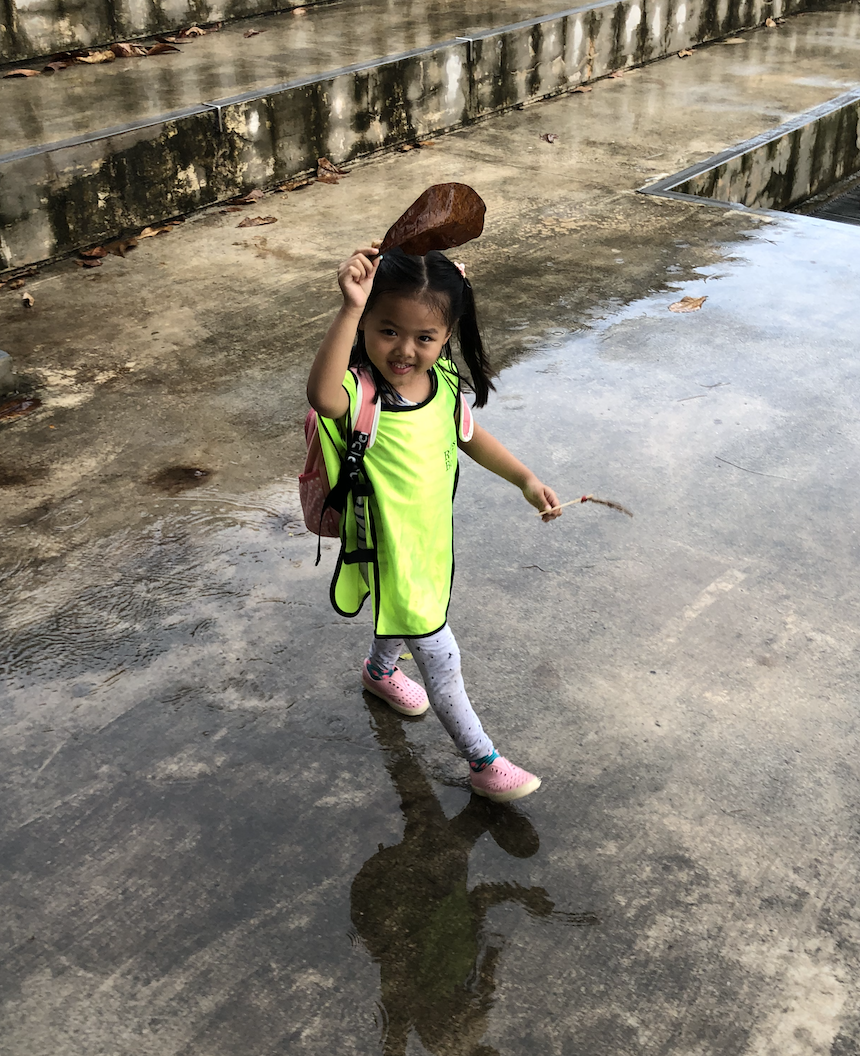
In local early childhood settings, children learn about weather. They discuss activities that can be done on a sunny day like going to the beach, or to the park to have a picnic. Typical rainy day activities involve staying indoors mostly at home, playing boardgames or reading a book. Maybe catching a movie at the cinema or going to the library if you are adventurous enough. What about playing in the rain? Stomping in puddles? To do so would mean hearing well-meaning people saying “you will fall sick”, “you will fall down”, or “you will get dirty”. But that wouldn’t be so if you are well-prepared, attire-wise. Raincoats can help you stay somewhat dry, and boots will protect your feet. Slippery ground is inevitable, but children wouldn’t know how to “be careful” if they don’t get the chance to experience and learn how to walk on wet surfaces.

Screenshot 2019-05-05 at 3.31.23 PM.png

We, in Singapore, are fortunate to have rain episodes that don’t last long (typically). We also have many sheltered areas even within outdoor spaces built for respite from the elements (heavy rain or scorching sun) that are free for us to use - so why not make use of them?

Life isn’t about waiting for the storm to pass, it’s about learning to dance in the rain.

- Vivian Greene

During rainy season, our Thursday class at East Coast Park experiences quite a bit of rain. Most days it stops less than half way through the session and what we get are unique perspectives of the park/beach while it’s raining AND just after it rains. Things look, smell, and feel different after a rain shower. Children learn about rain, about properties of water, about wet and slippery surfaces. They learn about friction as they try to walk on a wet floor, and can literally feel the difference when walking on a wet road or wet ground. They are balancing, they are coordinating their movements, and are controlling their strength. Their understanding deepens as they problem-solve and make decisions based on what they know.

Don’t let these learning moments slip by. Go out and explore (perhaps in the rain?)!